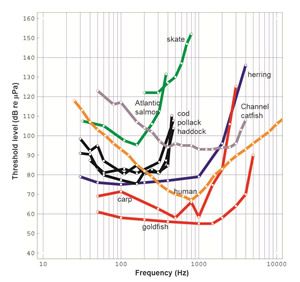
Research conducted by ICER in collaboration with the Institute of Sound and Vibration Research (ISVR) includes experimental based studies to quantify fish response to acoustics. Information is being collected on the behaviour of multiple species of fish in response to different acoustic signals to understand potential impacts of new energy and water supply infrastructure and to provide the basis for the design of technology that might be used to deter fish from hazardous areas e.g. turbine and water intakes. The experimental research is supported by information obtained through field studies conducted using 3D acoustic telemetry to track downstream migrating fish as they approach acoustic deterrents (infrasound).
The challenge described is not unique to the UK, but common to the wider international community. The integration of the disciplines involved makes this research field highly innovative and will help establish ICER as world leaders in the assessment and mitigation of environmental impacts of renewable energy and water supply development.
Research Projects
Exploring the effect of acoustic stimuli on Pacific Lamprey
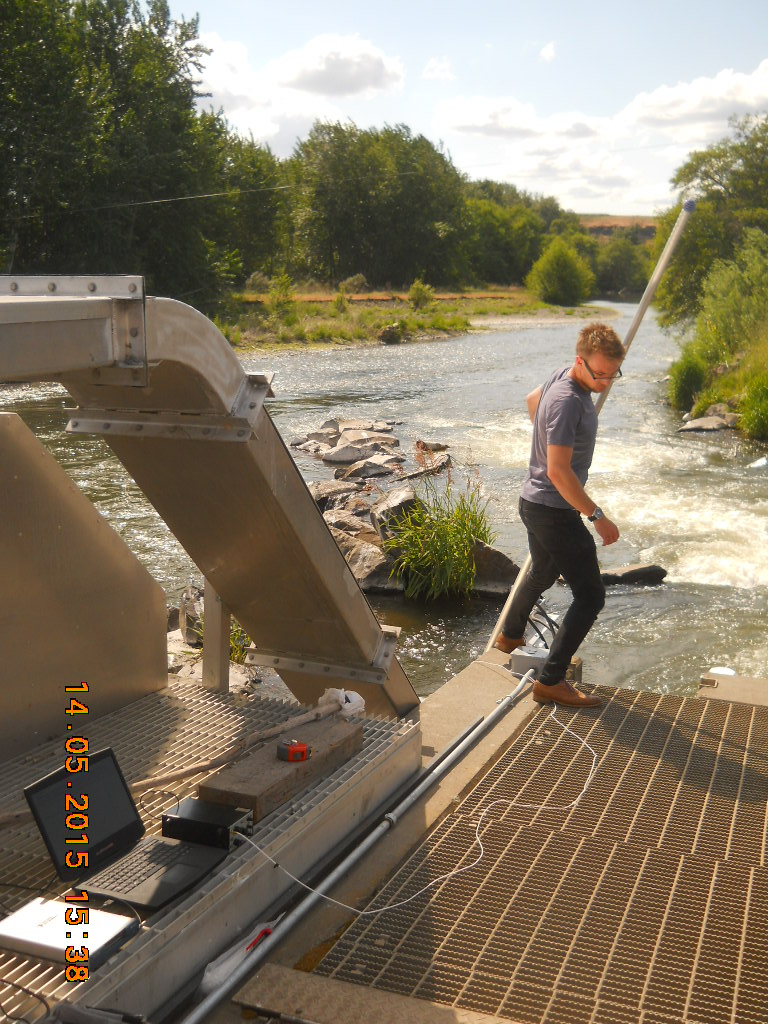
Fisheries scientists working with Pacific Lamprey (Lampetra tridentate) noticed rejection behaviour at a particular fish pass that was of similar design to others in the area. Between ICER and the local fisheries scientists it was hypothesised that this was due to acoustic signals generated by the fish pass in turbulent water. A research project was established in partnership between ICER and the United States Geological Survey (USGS) that aimed to improve the passage efficiency of upstream migrating Pacific Lamprey in the Columbia basin. Lamprey passes at various dams along the Umatilla River in Oregon, US were mapped for signs of potential acoustic disturbance to migrating Lamprey. Captive Lamprey were then exposed to broadband noise under laboratory conditions and their response measured. The current research focus is to quantify their behavioural differences under acoustic treatment. It is hoped that understanding the acoustic conditions surrounding Lamprey passes and the associated behaviours will allow increased passage efficiency through better fish pass design. A special thanks to the Confederated Tribes of the Umatilla Indian Reservation for allowing access to their land and Lamprey throughout the running of this project. People: Matt Short Prof. Paul Kemp Michael Hayes Prof. Paul White Dr. Mary Moser Prof. Tim Leighton |
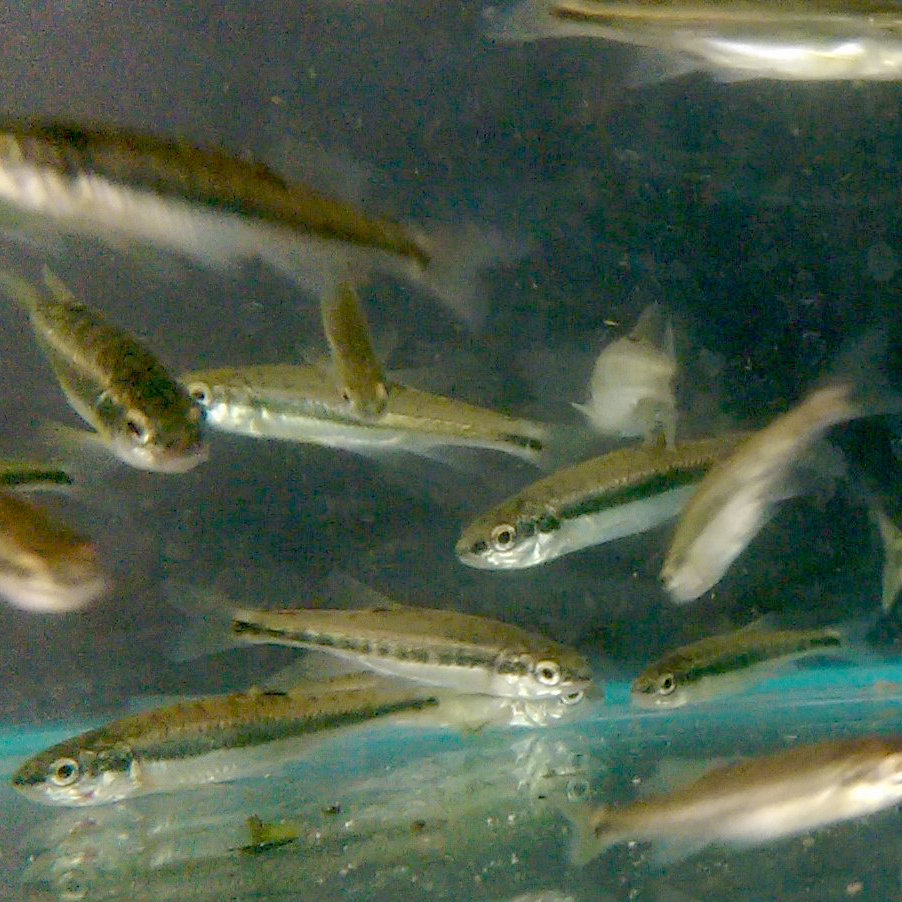
The Effect of Acoustic Stimuli on Fish Schooling Behaviour Using experimental facilities at ICER, and working closely with the Institute of Sound and Vibration Research (ISVR), acoustic fields are generated and mapped. The movements of the subject fish are recorded and tracked relative to alternative sound fields. By using state-of-art filming and particle tracking techniques, reactions are observed and analysed relative to positional data of the fish to quantify how spatial distribution changes under different treatments in which acoustic pressure and particle motion is manipulated. Further, in the aquatic environment fish frequently form aggregations. Existing research concerning fish and acoustic stimuli has traditionally focused on solitary fish or small groups. Our research compares between the two. It is hoped that this research will lead to the development of more efficient environmental impact mitigation technology, such as behavioural fish screens / deterrents.
People: |
Developing behavioural guidance/deterrent devices for adult European eel
The results of this research programme will be used to formulate a behavioural rule-base of values for developing efficient non-mechanical screening devices to prevent ingress of fish into hazardous areas.
People: |
Investigating impacts of human underwater sounds on fish behaviour
Results from these experimental studies will inform our field based research into acoustic deterrents and have direct application to behavioural screening devices. People: |
The impacts of noise pollution from marine transport and infrastructure on fish
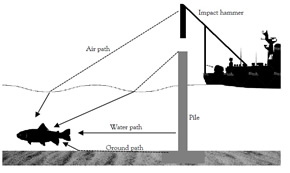
Infrastructure associated with shipping such as port development often uses pile driving during construction, an intense, impulsive sound source that has already been seen to affect many fish species. Research at the ICER will investigate the effects of vessel related noise on fish; focusing on the impacts of noise, masking and vibrations on behaviours of keystone, commercial and conservational important species. This project will start by investigating an adaptation (the Lombard effect) that can overcome the effects of This research will determine whether fish populations can adapt quickly enough to survive in areas of noise pollution. If they cannot, there may be serious consequences for marine food webs and the fisheries industry. This EPSRC and FugroEMU Ltd funded project will provide research to aid in setting criteria necessary for legislation to limit levels of noise pollution from anthropogenic activities. People: |